Tidal features as tracers of galaxy merger histories: the colours of tidal features in HSC-SSP
Published in MNRAS, 2026.
I'm an astrophysicist who recently completed a PhD studying how galaxies interact, merge, and evolve over time. My research has taken me developing AI and machine learning tools to improve galaxy merger detection, to analysing the properties of merging galaxies, to creating realistic mock observations from large-scale galaxy simulations. I've had the opportunity to publish my work in some of the leading journals in the field and present it at conferences in Australia and overseas. While astrophysics has been a fascinating field to explore, I'm increasingly interested in applying the same curiosity and analytical thinking to more down-to-earth problems closer to everyday life.
After my PhD, I was employed in a fixed-term role as a Research Associate. In this role I was tasked with developing tools to create realistic synthetic images of galaxies using cosmological simulation data. I used the radiative transfer code SKIRT and built a Python-based pipeline that automated the conversion of simulation outputs into telescope-like observations, with the goal of allowing researchers to compare theoretical models with real astronomical data. I also produced documentation and configurable workflows to ensure the pipeline could be used and adapted by other researchers.
During my PhD, my area of focus was galaxy evolution, more specifically the detection of merging galaxies using galaxy images from optical imaging surveys, and investigating what the population of merging galaxies could tell us about their formation and evolution. When galaxies merge with each other, the immense gravitational forces cause stellar material to be pulled out of the galaxies, forming diffuse regions of stars around the galaxies, known as tidal features. Studying these tidal features and their host galaxies can teach us a lot about the galaxy evolution process. My PhD research can be separated into three sub-projects, each associated with a publication in a Q1 peer-reviewed academic journal (MNRAS). The link to each publication is provided below.
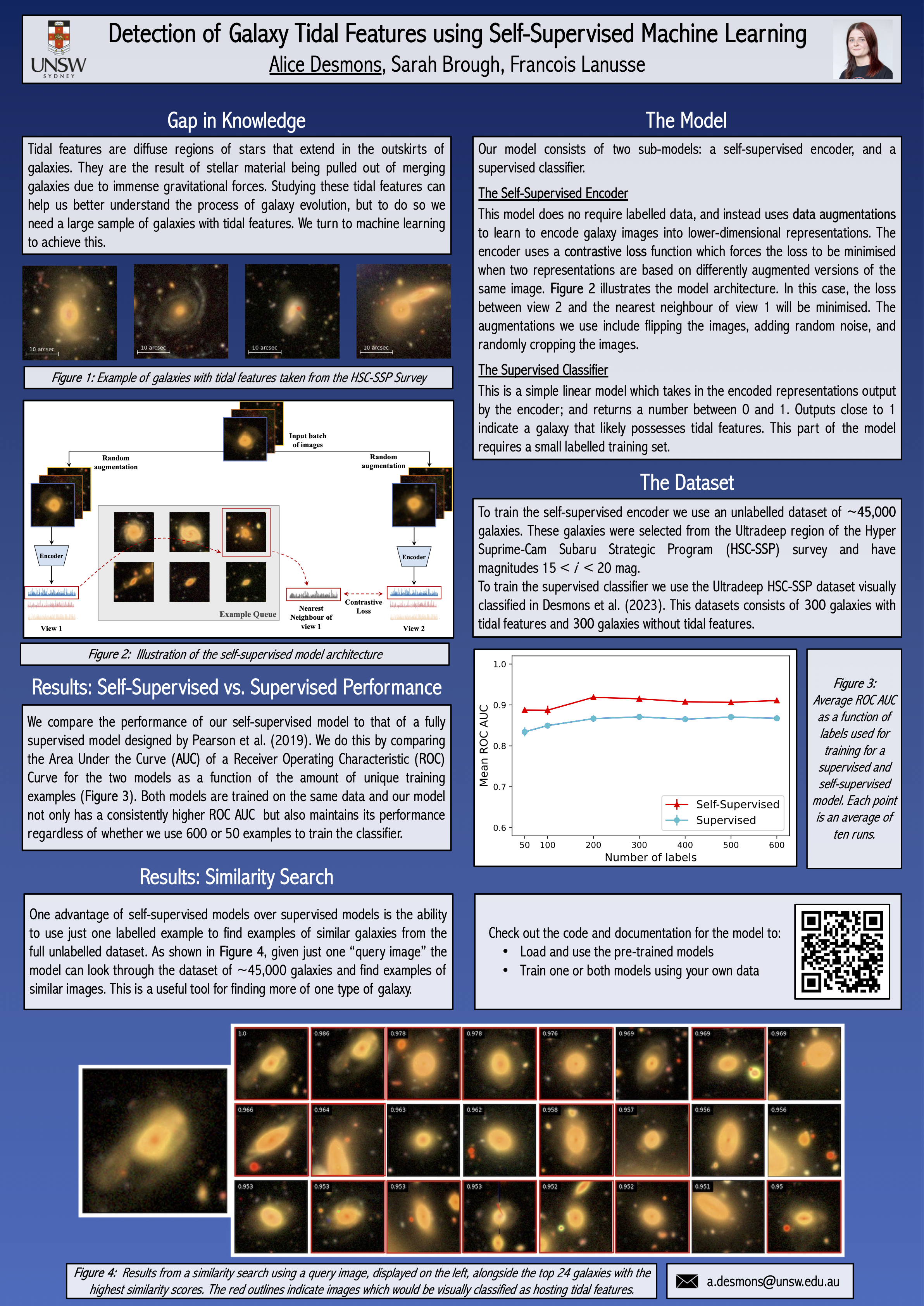
In this project, I aimed to address the issues associated with the detection of galaxies with tidal features. As the new generation of optical imaging surveys produce larger and larger datasets of galaxy images, the detection of galaxies with tidal features using purely human classification is becoming increasingly unfeasible. To address this issue, I developed a self-supervised machine learning model to automate the detection of galaxies exhibiting tidal features. This model was trained on data from the Hyper Suprime-Cam Subaru Strategic Program (HSC-SSP) survey. The model was found to outperform other state-of-the-art supervised machine learning models available at the time, and its self-supervised architecture greatly reduced the amount of labelled data needed to train the model.
In the second project, I used this machine learning model alongside visual classification to assemble a large sample of galaxies with tidal features from HSC-SSP. I then investigated the prevalence of tidal features in galaxies, and how this prevalence changed with galaxy properties such as stellar mass, the mass of the dark matter halo in which they resided, and the redshift of these galaxies. My final sample consisted of ~34,000 galaxies, 1646 of which had visible tidal features. I found that the prevalence of tidal features increased with stellar mass, and decreased with redshift, although this relationship with redshift could be attributed to the fact that tidal features are more difficult to detect at higher redshifts. I also found that galaxies in groups had higher rates of tidal features than more isolated field galaxies, or galaxies in denser cluster environments.
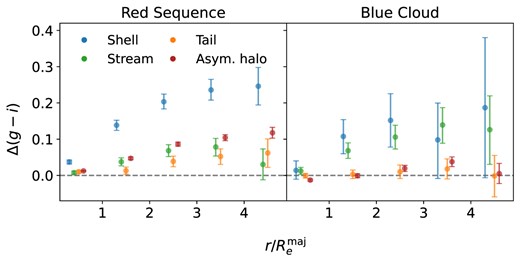
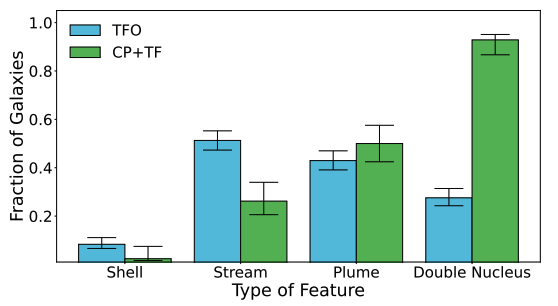
In the third project, I used this same sample of galaxies to investigate the colours of tidal features in galaxies. Since the colours of galaxies reflect the age and metallicity of their stellar populations, and are correlated with their stellar masses, I wanted to know if the colours of tidal features could be used to draw conclusions about their progenitor galaxies. To do this, I designed a pipeline to model the light from galaxies in my sample and attempted to isolate the light from the tidal features. I found that tidal features were generally bluer than their host galaxies, and that red sequence galaxies with tidal features had redder outskirts than their non-tidal feature hosting counterparts, consistent with the outskirts of galaxies being composed of light accreted through mini and minor gas-poor mergers as predicted from theory and simulations. I also found evidence consistent with different types of tidal features having different formation mechanisms. More importantly, I demonstrated that an automated pipeline designed to compare large statistical samples of galaxies could be used to detect colour differences between tidal features and their host galaxies.
Published in MNRAS, 2026.
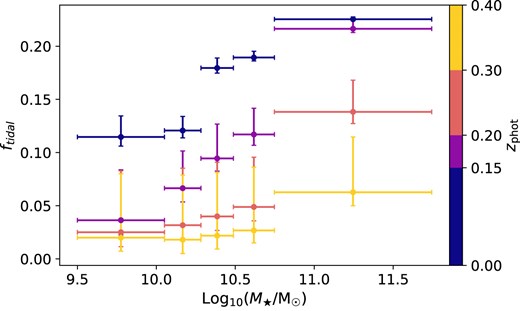
Published in MNRAS, 2025.
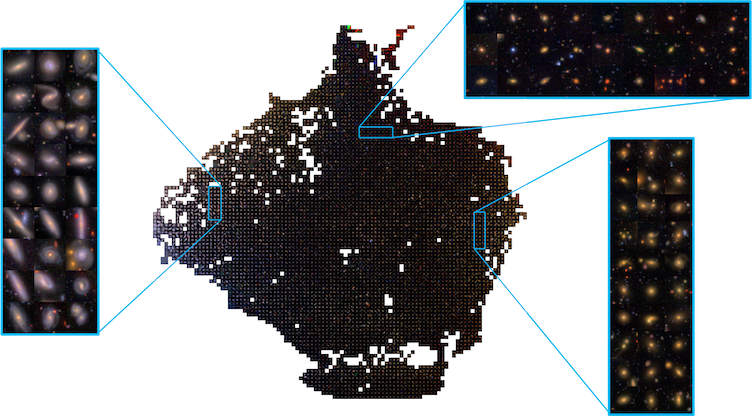
Published in MNRAS, 2024.
Published in MNRAS, 2023.
Presented at ASA 2023
From SSL paper
Like most scientists, I love talking about my work, so feel free to email me with any questions about my work, my code, ideas for collaborating, or just to chat. My email is: